2025-2026 Supreme Court Constitutional Review
The Supreme Court has released significant decisions during the 2025-2026 term, and the Judicial Action Group Foundation is excited to release a Constitutional Review of 14 major decisions during this term of the court.
In this report, you will find the Constitutional rating of each decision, summaries of each case, and a tiered rating for each of the Supreme Court Justices.
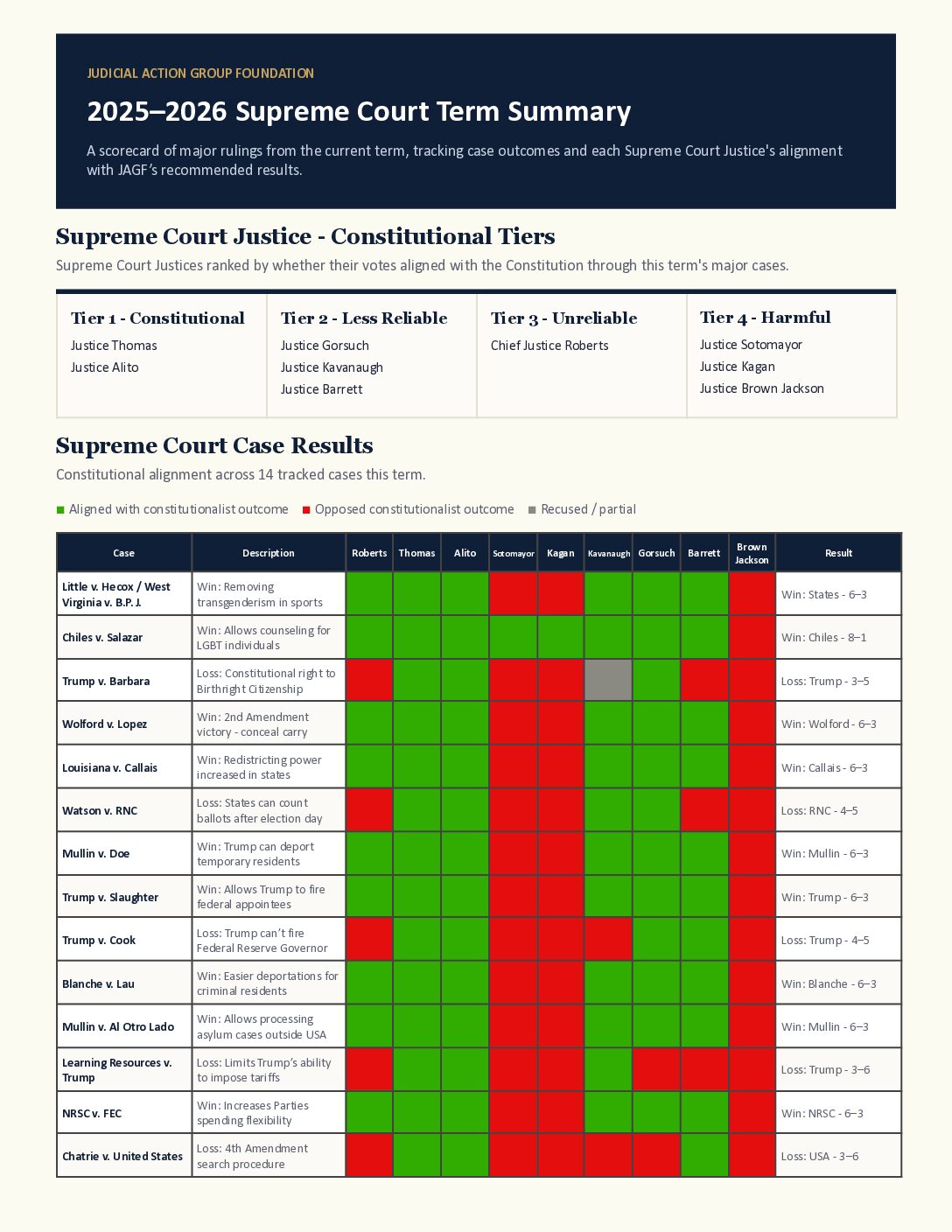
West Virginia v. B.P.J. – The Court held that West Virginia and Idaho laws separating women’s and men’s sports teams based on biological sex did not violate Title IX or the Equal Protection Clause of the Fourteenth Amendment.
Chiles v. Salazar, Executive Director of the Colorado Department of Regulatory Agencies – The Court held that a Colorado law banning conversion therapy, as applied to talk therapy, violated the First Amendment.
Trump v. Barbara – The Court held that the phrase “subject to the jursidiction” in the Fourteenth Amendment applied to children born in the United States to parents who are unlawfully or temporarily present meaning those children are citizens at birth.
Wolford v. Lopez, Attorney General of Hawaii – The Court ruled that Hawaii’s law prohibiting licensed concealed-carry permit holders from carrying handguns on private property open to the public without the property owner’s express authorization violates the Second and Fourteenth Amendments. (Verbatum from Case)
Louisiana v. Callais – The Court ruled that Louisiana had no compelling interest to create race based majority-minority districts and that the legislative drawn map was an unconstitutional racial gerrymander.
Watson, Mississippi Secretary of State v. Republican National Committee – The Court ruled that states (in this case, Mississippi) may count absentee ballots received after the Election Day that were postmarked on Election Day because the vote of the individual submitting the absentee ballot did take place on Election Day.
Mullin, Secretary of Homeland Security v. Doe – The Court held that several challenges to the Secretary’s termination of Temporary Protected Status, including objections committed to agency discretion, were not subject to judicial review and that the equal protection claims were unlikely to succeed, allowing the Administration to proceed with terminating TPS designations for Syria and Haiti.
Trump v. Slaughter – The Court ruled that the President could fire Federal Trade Commission appointees, because the FTC for-cause removal provision is contrary to the separation of powers enshrined in the Constitution. In order to remoain accountable to the President, officers appointed by him must be removable by the President.
Trump v. Cook, Federal Reserve Governor – The Court upheld a lower court prelimary injunction that barred the removal of a Federal Reserve Governor by President Trump, because among other issues, the Govenor was not granted sufficient time to respond to the “for cause” rationale for her removal. The Court argued that the public private nature of the Federal Reserve is why the for-cause provision is necessary.
Blanche, Acting Attorney General v. Lau – The Court ruled that a permanent resident status was rightfully categorized as an applicant for admission due to a pending criminal case involving trademark counterfeiting (and thus, subject to removal upon conviction) and that clear and convincing evidence was not necessary for a border officer to deem him applicant for admission.
Mullin, Secretary of Homeland Security v Al Otro Lado – The Court ruled that an allien attempting to seek asylum does not arrive in the United States only when he physically enters the United States. Thus, the Immigration and Nationality Act does not require an immigration officer to process an asylum seeker standing in Mexico.
Learning Resources, Inc. v. Trump – The Court held that the International Emergency Economic Powers Act does not authorize the President to impose tariffs.
National Republican Senatorial Committee v. FEC – The Court found that politically coordinated-expenditure limits imposed by the Federal Election Campaign Act violated the First Amendment, because earmarking and diclsclosure laws are less-speech-restrictive options to prevent the cirucumvention of the base statutory limits on contributions.
Chatrie v. United States – The Court held that law enforcement’s acquisition of a person’s Google Location History through a geofence warrant constitutes a Fourth Amendment search because individuals have a reasonable expectation of privacy in their cell-phone location data, and remanded for the lower courts to determine whether the warrant satisfied the Fourth Amendment’s probable cause and particularity requirements. The Dissent argued that their was no expectation of privacy because the individual voluntarily disclosed location to Google and that certiorari should not have been granted.
Related Posts

3 Ways to Pray for the Supreme Court This Month
Every month, the U.S. Supreme Court takes on decisions that have far-reaching effects—on our...

When Judges Act Like Presidents—How the Branches Can Respond
In his op‑ed, “Fake Little Presidents in Black Robes,” Phillip Jauregui issues a stirring...
When Judges Overstep: Understanding the Threat of Judicial Activism
Following sweeping electoral losses, the left is doubling down on judicial activism—not by...